
Snowmobile Insurance
Snowmobile insurance is compulsory in this province the moment you ride off land you own, at a minimum limit twice what most of the country requires. The trail pass on your windshield is not it, and buying one does not prove you have it. This page covers what the law asks for, what the policy answers to, and the handful of conditions — ice, modifications, who is riding — that decide whether a claim is paid.
What Snowmobile Insurance Covers
Snowmobile insurance is written on a motor vehicle liability form rather than as an extension of your home or auto. Part of it is compulsory, part of it is yours to choose, and the choosing is where the real decisions sit.
- Third-party liability — compulsory. Injury or property damage you cause to other people. Nova Scotia sets the floor at five hundred thousand dollars, which is more than double what New Brunswick, Prince Edward Island and Newfoundland and Labrador require. One or two million is what most riders should actually be carrying.
- Accident benefits — compulsory. Medical treatment, rehabilitation and income replacement for you and your passenger, paid regardless of fault. Four in five snowmobile deaths in this country are single-vehicle events, which is precisely the scenario where there is no other party to claim against.
- Uninsured and unidentified motorist — compulsory. Answers when the other rider carries nothing, or is over the ridge before anyone gets a registration number.
- Collision or upset — optional, until it is not. Damage to your own machine, whoever caused it. Optional in law, required in practice by every lender that finances a sled.
- Comprehensive, specified perils or all perils — optional. Theft, fire, vandalism, weather and animal strikes. This is the coverage that matters in July, when the sled is in the shed and nothing else on the policy is doing anything.
- Gear, accessories and depreciation waivers — optional and easily missed. Helmets and riding gear are commonly available up to a set limit once declared, and several markets will waive depreciation on a new machine for a period of years.
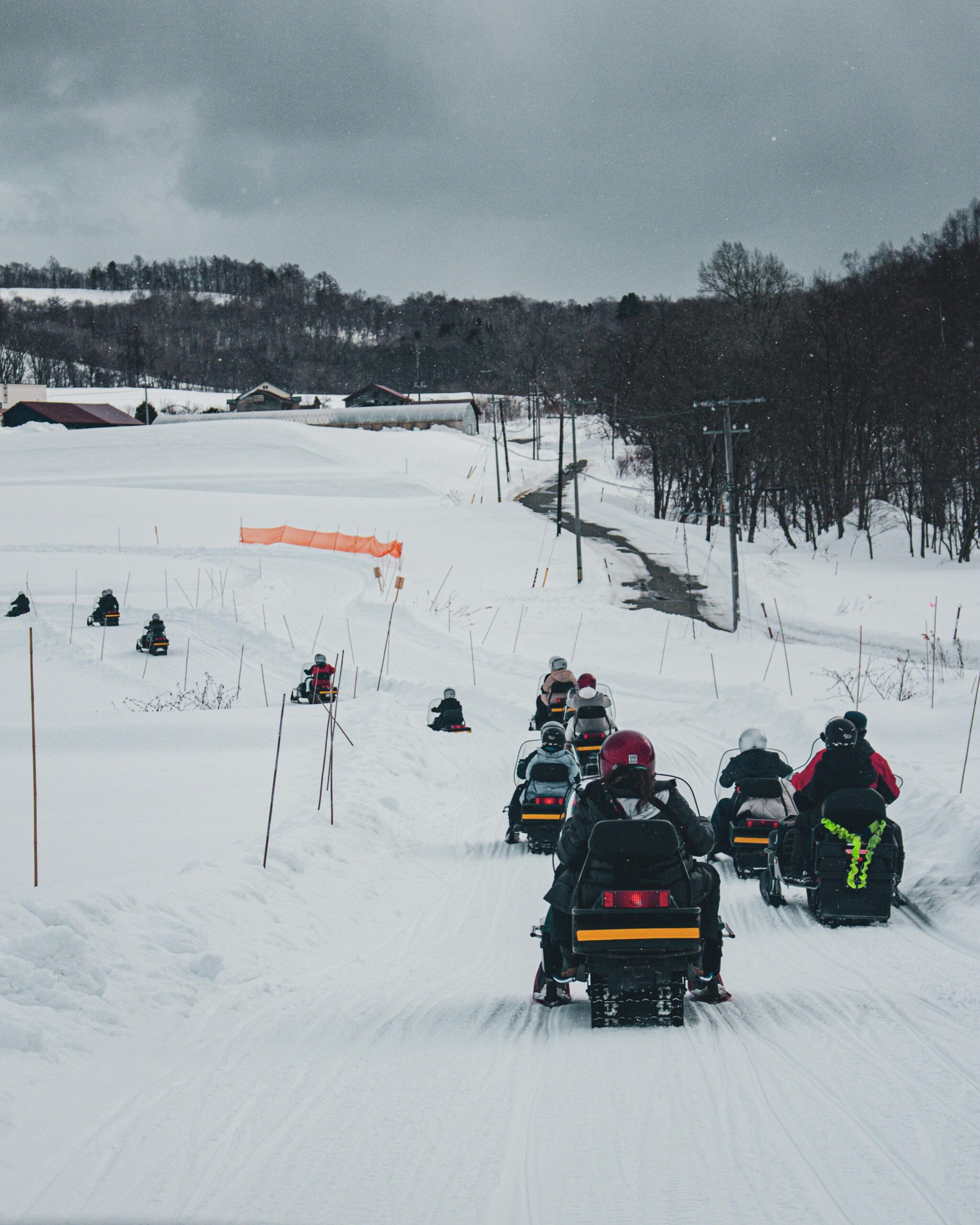
Where the Law Requires It
All four Atlantic provinces require registration and liability coverage once the machine leaves the owner’s own land. The limits and the details are not the same, and Nova Scotia is the outlier at the top. It sets what your snowmobile insurance has to carry.
Nova Scotia
Registration with the Registry of Motor Vehicles and a minimum of five hundred thousand dollars in third-party liability, plus accident benefits and uninsured motorist coverage — in force since 2007. Helmets are mandatory for driver and passenger, and a passenger may only be carried where the machine was built with a seat for one. Riding only on land you or your family own removes both requirements.
New Brunswick
Annual registration, a plate, and compulsory liability and accident benefits written off the province’s two hundred thousand dollar automobile minimum. The provincial federation states plainly that the trail permit does not include that insurance — it is a separate purchase, and proof has to be carried.
Prince Edward Island
Registration is required to operate and expires at the end of November each year. A valid driver’s licence is needed to cross any road, and riding along the shoulder is prohibited. Riders under sixteen must be accompanied by an adult who holds a licence, and that adult crosses roads on the youth’s behalf.
Newfoundland and Labrador
The rules were rewritten in 2022. Helmets became mandatory for every operator and passenger on every off-road vehicle, seatbelts must be worn where the manufacturer fitted them, and first-time registrants must complete approved safety training. Proof of insurance and training has to be produced within two business days of a request.
What Drives Your Snowmobile Insurance Premium
Snowmobile insurance premiums sit at the modest end of personal lines, which is why almost nobody examines how they are built. Six things move the number.
The machine
Model year, declared value and engine size. Trail, touring, crossover, utility and mountain sleds are five different risks to an underwriter, and a performance machine is not rated like a two-up touring sled.
Who is riding it
Age, years of experience and the household’s riding record. Age carries more weight on recreational vehicles than on almost any other personal policy, and a young rider on a high-displacement sled is the most expensive combination in the class.
Your record
Claims and driving convictions follow you onto the sled policy. It is rated as a motor vehicle and your record is read as one.
Where it lives
A locked garage rates differently from a machine parked beside the shed. Secure storage and an anti-theft device are among the few credits on this class actually worth chasing, and they matter most in the eight months you are not riding.
The coverages you choose
Liability limit, deductible, and whether you carry collision and comprehensive or liability alone. Moving from the legal minimum to a million or two costs very little on a policy of this size.
Training and bundling
A recognised safety course earns a credit with most markets — and is a legal requirement here in any case. Putting the sled with the same insurer as the home, the auto and anything else in the shed is usually the largest single discount available.
Theft, Storage and the Off-Season
Snowmobile insurance runs for twelve months on a machine that is ridden perhaps ten weeks. What happens in the other forty-two is where most of the avoidable losses sit.
- Keep comprehensive running through the summer. The temptation in April is to strip the policy back or cancel it. Theft, fire, vandalism and a shed roof under spring snow load do not observe a riding season, and comprehensive is the only coverage answering to any of them.
- Collision is the one you can reasonably suspend. It responds to impact while riding, so it is doing nothing between April and December. Talk to us about what comes off and what stays on rather than cancelling the whole policy.
- Storage is a rating factor and a real defence. A locked garage or a secured shed rates better than an open yard, and sleds are stolen from driveways with the keys out and the machine tied down. Where it sits matters more than what it is chained to.
- Photograph and record the machine before it goes away. VIN, engine serial, four sides with the accessories fitted, and the receipts for anything added. Theft claims on recreational machines turn almost entirely on documentation.
- Tell us before the trailer joins the household. How a trailer and the sled on it are covered in transit is not handled identically across markets, and it is a common enough claim that the answer is worth having in writing before the first haul of the season.
The April conversation
Ten minutes when the sled comes off the trail: what stays on the policy through the summer, where the machine is being stored, whether anything was added over the winter, and whether it is being sold. It is the cheapest call you will make all year.
What we ask at renewal
Anything added or modified, who is riding it now, where it is stored in and out of season, whether the trailer changed, and whether the riding has moved off the groomed trail system. Short conversation, and it is the whole job.
Ice, Open Water and Where Claims Go Wrong
Nationally, an average of seventy-three people a year are killed snowmobiling. Four in five of those are single-vehicle events, roughly half involve alcohol or drugs, and a third involve excessive speed. The pattern of the fatalities and the pattern of the declined claims are close to the same list, and snowmobile insurance is written around it.
Ice is a coverage question, not just a safety one
Markets treat these differently and the distinction generally falls between an accident that happens on ice and deliberately running a machine over open water. Submersion accounts for a meaningful share of single-vehicle deaths, and across Atlantic Canada ten off-road fatalities since 2018 involved riders entering open water or breaking through. Ask us how your wording reads before the season, not after.
Impairment ends the conversation
Roughly half of snowmobile fatalities in this country involve alcohol, cannabis or other drugs. Impaired operation is an offence and sits outside every snowmobile insurance policy in the class. There is no version of this that ends well.
Racing is outside the policy
Competitive events and speed contests are not what a recreational policy is rated for. Nova Scotia’s own regulations exempt machines used solely for racing by members of a registered racing club from the insurance requirement altogether — which tells you how differently that use is treated.
Permission and land
The insurance requirement exists because you are riding on land that is not yours. Riding without the landowner’s permission is a problem before it is ever an insurance problem, and it complicates everything that follows a loss.
Trail Permits and What They Do Not Do
This is the most expensive misunderstanding in the sport, it is about snowmobile insurance rather than trails, and it is worth being blunt about it.
What the permit buys
Access and grooming. The provincial association and its member clubs maintain roughly five thousand kilometres of trail across four zones in this province, negotiated over a mix of Crown land and private property, and the trail pass is what pays for it.
What it does not buy
Your insurance. The association carries its own liability policy, and that policy protects the association, its clubs and the landowners whose property the trails cross. It does not answer for the damage you cause riding, and nobody asks to see proof of your policy when you buy a pass.
Quebec is the exception that proves it
In Quebec the trail permit does include a million dollars of civil liability, arranged by the federation with an insurer. Nowhere in Atlantic Canada works that way. Here the pass and the policy are two separate purchases, and only one of them satisfies the Act.
Riders, Lending and Modifications
Six things that change your snowmobile insurance without changing the machine, and every one of them is a conversation better had in November than in February.
Age and supervision are law here
Nova Scotia runs a graduated framework. The youngest riders are limited to private land, closed courses or designated trails with a supervising parent present; fourteen and fifteen year olds may ride where the guardian can, staying in sight; and from sixteen there is no age restriction but safety certification is required.
Training is a requirement, not a discount
Approved safety training has been mandatory across the age groups in this province for well over a decade, with a narrow grandfathering exemption for older riders who owned a machine before 2006. It also earns a premium credit — that is the smaller of the two reasons to have it.
Lending the sled
Coverage generally follows the machine when it is ridden with your permission, provided the rider is legally entitled to operate it. An unlicensed rider is a different matter — at least one national market sells a specific endorsement for unlicensed operation on private property, which tells you the base policy does not go there.
Modifications need declaring
Aftermarket exhaust, clutch work, a studded track, a taller windshield, bags and electronics. Undeclared, the settlement is likely to be based on the standard machine, and genuinely performance-altering work that was never disclosed is worse than that.
Gear is its own coverage
Helmets, suits, boots and eyewear are not part of the machine, and not part of the snowmobile insurance on it. Several markets will schedule riding gear up to a set limit once it is declared, and on a household of riders that adds up faster than people expect.
Passengers and the two-up question
A passenger may only be carried on a machine the manufacturer built to carry one, on a designated seat. Newfoundland and Labrador now says the same and adds seatbelts where they are fitted. This is an offence before it is ever a coverage argument.
Frequently Asked Questions About Snowmobile Insurance
Is snowmobile insurance mandatory in Nova Scotia?
Yes. Snowmobile insurance is required the moment you ride off land you or your family own. The province has required liability coverage on off-highway vehicles since 2007 at a minimum of five hundred thousand dollars, along with accident benefits and uninsured motorist coverage, and registration is required on the same basis. Riding exclusively on your own property is the only exception, and it is a narrow one — the moment you reach a trail, a road crossing or Crown land, the requirement applies.
Why is Nova Scotia's minimum higher than the other provinces?
It simply is. New Brunswick, Prince Edward Island and Newfoundland and Labrador all work from their two hundred thousand dollar automobile minimums; Nova Scotia sets five hundred thousand. If you trailer the sled across a provincial line, you are riding under the rules of the province you are in — but there is no advantage to insuring down to a neighbour’s floor, and a serious injury claim will exceed any of these numbers without difficulty.
Does my trail pass include insurance?
No. In Atlantic Canada the trail pass and the snowmobile insurance policy are entirely separate purchases. The pass funds grooming and the club system, and the provincial association’s own liability policy protects the association, the clubs and the landowners whose property the trails cross — not you, for damage you cause riding. Quebec is the one province where a federation permit does include civil liability coverage, which is why the assumption travels.
Does my home insurance cover my snowmobile?
Not in any way you can rely on. A home or tenant policy may respond to a machine stolen or burned on your own property, subject to a special limit that is usually well below what a sled is worth, and its liability section is not built for operating a motorised vehicle. It also cannot satisfy the provincial snowmobile insurance requirement, which asks for a motor vehicle liability policy specifically.
Should I cancel coverage over the summer?
No. Comprehensive is the coverage that answers to theft, fire and vandalism, and none of those stop when the sled comes off the trail — most machines are stolen while stored, not while ridden. Collision is the piece that can reasonably come off for the off-season, since it responds to impact while riding. Call us in April and we will strip the snowmobile insurance back sensibly rather than cancelling the whole policy.
Am I covered if my sled goes through the ice?
It depends on how it happened and on how your particular wording reads. Markets generally distinguish between an accident that occurs on ice and deliberately running a machine across open water, and the second is the one that gets declined. Given how much of the riding in this province involves lakes and inlets, this is worth confirming specifically before the season rather than assuming.
Are my modifications and accessories covered?
Only once they are declared on the snowmobile insurance. Aftermarket exhaust, clutching, a studded track, a taller windshield, bags and electronics all need to be on the policy. Undeclared, a settlement is likely to be worked out on the standard machine, and performance modifications that were never disclosed create a bigger problem than a shortfall. Riding gear is separate again and commonly available as a scheduled add-on.
Can I lend my snowmobile to a friend?
Generally yes, where they ride with your permission and are legally entitled to operate the machine — which in this province means the required safety certification. An unlicensed or uncertified rider is where it goes wrong; at least one national market sells a specific endorsement covering unlicensed operators on private property, which is a fairly clear signal that the base policy does not reach that far.
What are the rules for young riders?
Nova Scotia uses a graduated framework rather than one minimum age. The youngest riders are restricted to private land, closed courses or designated trails with a supervising parent or guardian present and certified; fourteen and fifteen year olds may ride where their guardian can while staying in sight; and from sixteen there is no age restriction but safety certification is required. Both the young rider and the supervising adult need to be able to produce proof of training.
How much liability should I carry?
Five hundred thousand is the floor in this province, not a recommendation. Most riders should be at one or two million, and some markets will write up to five. The step up costs very little on a policy of this size, and the exposure is real — a collision on a groomed trail involving a passenger can generate a claim well beyond the statutory minimum.
What should I do if my sled is stolen?
Report it to the police and to us the same day, and have the VIN, the engine serial and a list of accessories ready. Theft is the single most common off-season loss on these machines and the claim turns almost entirely on documentation, which is why photographing the sled before it goes into storage is worth more than any other preparation you can do.
Related Personal Insurance Coverages
Most households with a sled in the shed have at least one of these as well, and putting them alongside the snowmobile insurance with one insurer is usually the largest discount available.
For everything else the household carries, and how the pieces are reviewed together, see personal insurance.
Schedule a Consultation Today
Personalized insurance and surety solutions backed by decades of industry expertise.
Reach out to us today and experience the Stanhope difference!